Showing posts with label Architecture. Show all posts

Monday, 20 July 2015

Serpentine Gallery Summer pavilion

A personal approach to The Serpentine Pavilion (2015), designed by ‪‎SelgasCano‬,
while walking through Hyde Park, under Kensington Palace views, for a tea, coffee and talk on...
... ways to be awarded a degree, by means of outstanding contributions to knowledge.

Friday, 17 October 2014

Gordon Shrigley: Heaven’s Gate

Gordon Shrigley
Heaven’s Gate
IMT Gallery
The Brazilian architect Oscar Niemeyer (1907 – 2012) once said something along these lines: for me beauty is valued more than anything – the beauty that is manifest in a curved line or in an act of creativity. It is on the sensual and liberated curves that we perceive life’s soundscape, not on straight, hard and inflexible lines created by man.

Some time ago in a passionate conversation about religion and deliberate choices, while dinning at a restaurant lost in the midst of the countryside, someone (non-European) expressed that the previous Pope, Benedict XVI, was a Nazi, because he was conscripted into the Hitler Youth. However, this idea clearly aroused the indignation of almost all of the people at the table not for religion’ or political’ reasons, but, instead, for a lack of cultural knowledge and understanding and it was also obnoxious how people from a particular region in the world perceive the history of the world and cultural difference. Most of the people at the table, under 50-years-old, were from European countries that until the 1970s had been under a fascist regime, and perceived that commentary as a rude vision on how other people might perceive world history and bring their local different perceptions of the world.

Life is made of curves, not of straights lines, and when Ratzinger joined the Hitler Youth, in 1941, membership was require by law for all 14-years-old German boys after March 1939. Being part of a nationalist youth organization, until the 1970s, is like, presently, all of us having to have an email account and a mobile phone, even if not required by law, or we like it or wanted it or not! It is demanded by society at large.

The dissemination of totalitarian ideologies, believes and modes of behavior led by the propagation machine in the XX century, is, today, communicated by those informational channels being demanded by society. Non-places where the political corrects breeds! For the matter, it would be useful to think about which images circulate by and in the social sphere! So, my point here is that if what he had seen is that straight line (and imperialist view imposed over the world multitude), what curves given us by is what goes beyond over those fatalistic imagery conditions defining Democracy, State, Freedom, Islam, Terrorism, etc.

It is on those moments that sound start to emerge. I’m thinking about Gordon Shrigley work (presently at IMT Gallery in London) Heaven’s Gate comprising 14 slabs of straight small lines of chalk on painted board as musical compositions. An endless vocabulary of things describing that that was and is around us, with each slab resonating different soundscapes and compositions. It sprouts from the most inconvenient places and moments.

Monday, 24 February 2014

Sensing Spaces - Architecture Reimagined

Sensing Spaces - Architecture Reimagined
Royal Academy of Arts


«How do spaces shape our lives?
How do they make us feel?


Experiencing architecture involves moving within and around it, absorbing its qualities through our bodies and senses. We react, consciously or not, to the characteristics of different materials, vistas, volumes, sounds, spatial relationships and proportions. As well as engaging physically with space, our experience of it is also informed by our memories and habits.

Human responses to architecture range from awe to feelings of comfort, safety, pleasure, excitement or unease. We frequently shape the spaces around us - from making dens as children to placing furniture in a living room. Ultimately, architecture connects us to time, place, and people.

This exhibition invites you to explore built space directly. The installations all highlight different aspects of architecture - from the manipulation of light, mass and structure to the transformations brought about by use, movement and interaction.» 


[exhibition text]
Pezo von Ellrichshausen
Diébédo Francis Kéré
To move forward, people need to be inspired: they need buildings that enhance their creativity into their own hands. - Diébédo Francis Kéré
Diébédo Francis Kéré
"I believe it is important to engage people in the process of building so they have an investment in what is developed. Through thinking and working together people find that the built object becomes part of a bonding experience."
Diébédo Francis Kéré
Eduardo Souto de Moura
"For me, architecture requires continuity; we have to continue what others have done before us but using different materials and methods of construction."
Kengo Kuma
"I always start with something small, breaking down materials into particles or fragments that can then be recombined into units of the right scale to provide comfort and intimacy."
Kengo Kuma
Li Xiaodong
"According to the ancient Chinese philosopher Lao Zi, what is important is what is contained, not the container."
Li Xiaodong
Li Xiaodong
Li Xiaodong
Li Xiaodong
Li Xiaodong
Grafton Architects
When are you aware of spaces you inhabit? Thresholds are places where we naturally become more aware. For me this occurs each time I leave the quite complex of Trinity College in Dublin. - Yvonne Farrell, Grafton Architects
Grafton Architects
"There is a sense of pleasure in moving from darkness to light or vice versa because as human beings we're cyclical. How light reflects and how light is contained is the stuff of architecture."
Álvaro Siza Vieira

Saturday, 30 November 2013

The Uneventful Day: Jim Woodall, Alexander Page and Luke Burton

Jim Woodall, Alexander Page and Luke Burton
The Uneventful Day
Carroll / Fletcher


Luke Burton, The Insistence of Form (30x20cm, series of 29 photographs), 2011-2013
Alexander Page, Myself not least (158x127cm, digital C-type), 2013
Alexander Page, A wide sweep of solitude (50.6x63.5cm, C-type mounted on aluminium), 2012
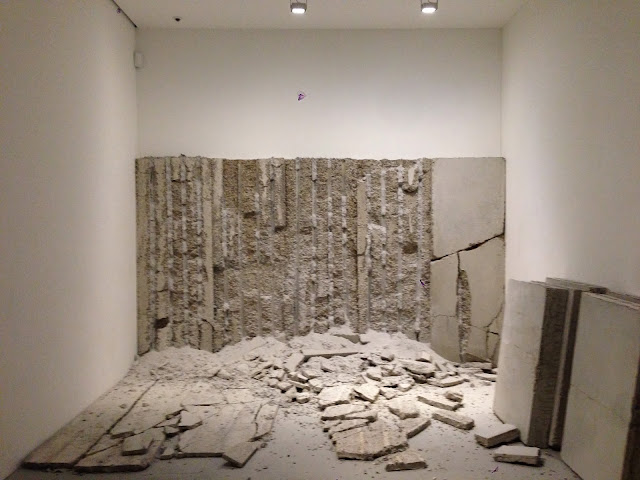
Jim Woodall, You Have to Keep Building To Make It Stand (concrete, steel, plastic, fabric, calcium oxide and ferric oxide), 2013
Luke Burton, High Line (HD video, 6'), 2013
Alexander Page, How I Felt About You Then and How I Feel About You Now (101.6x127cm, C-type mounted on aluminium), 2008-2013
Jim Woodall (b.1978, Oxford) lives and works in London. Woodall works across diverse media: sculpture, photography, video, installation and performance. His work stems from a personal and socio-political encounter with the built environment and reflects upon land ownership, human-led accelerated entropy and how technology affects our relationship with and memory of landscape.
Recent exhibitions include Tomorrow People, Elevator Gallery, London, 2013; React, Dilston Grove, 2013 and Olympic State, See Studios, London, 2011.
Woodall was a founding member of CutUp collective, an interventionist art group, from 2004-9.

Alexander Page (b. 1983, London) lives and works in London. Page's work engages with memory and landscape. Landscape is used as a foil or a cipher to unlock direct relationships with the self, memory, nostalgia, loss and love. His work speaks of wandering, nostalgic journeys, of days spent lost in reverie but also of art and image making as a form of release from melancholia.
Recent exhibitions include A Dense Glitter of Alternatives, Vitrine Gallery, London and Like a Monkey Puzzle Tree, Copeland Park Gallery, London (as part of the Art Licks festival), both 2013.

Luke Burton (b.1983, London) lives and works in London. Burton's work crosses sculpture, installation, photography, video and drawing to explore the irreducible complexity of aesthetic reception and pleasure, and probe the convoluted relationship between architecture, class and taste. Humour and play infiltrate a restrained and serious language of the decorative within his work and enable a critical dissidence from formal and socio-political constraints.