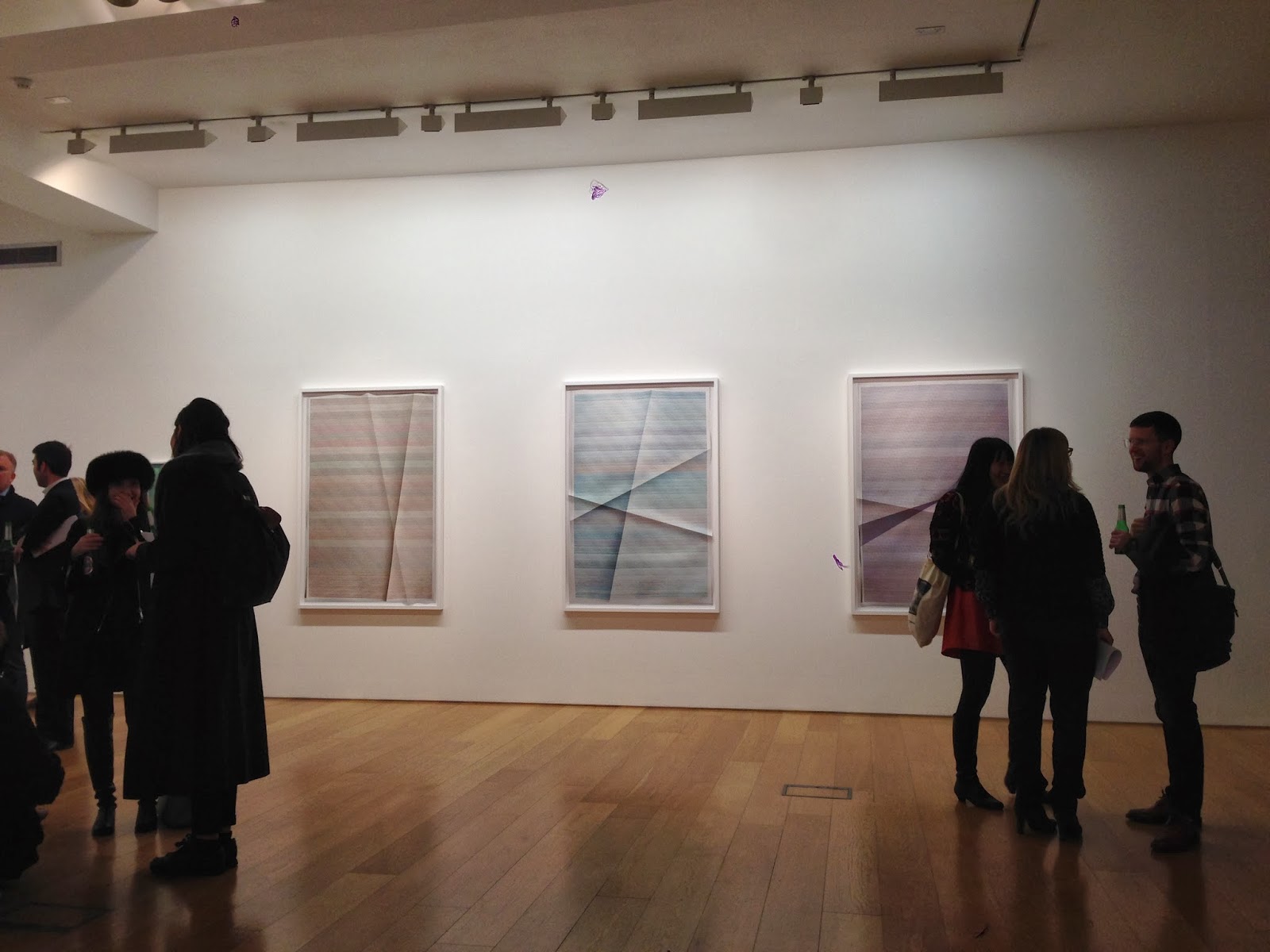
Diogo Pimentão
Transitory Capture
Cristina Guerra Contemporary Art
Diogo Pimentão, Cristina Guerra Contemporary Art, Exhibition, Works with paper, Graphite, Drawings,
Diogo Pimentão : Transitory Capture
Showing posts with label Drawings. Show all posts
Wednesday, 23 December 2015
Sunday, 1 March 2015
ARCOmadrid 2015
![]() |
| Fernando Bryce, To The Civilized World, 2014 [Detail], at Galerie Barbara Thumm. |
![]() |
| ARCOmadrid 2015 |
![]() |
| ARCOmadrid 2015 SOLO PROJECTS |
![]() |
| Sophie Ristelhueber, WB, 2005, at Galerie Jérôme Poggi |
![]() |
| Diogo Pimentão at Schleicher & Lange |
![]() |
| João Onofre, Universal Declaration of Human Rights and an Image of Beauty Converted into Binary Code (N version), 2014, at Cristina Guerra Contemporary Art |
![]() |
| João Onofre, Universal Declaration of Human Rights and an Image of Beauty Converted into Binary Code (N version), 2014 [Detail], at Cristina Guerra Contemporary Art |
![]() |
| Herbert Brandl, Untitled, 2015, at Bärbel Grässlin |
![]() |
| Cristina Lucas at Galeria Juana de Aizpuru |
![]() |
| Cristina Lucas [Detail] at Galería Juana de Aizpuru |
![]() |
| Eugenio Ampudia at Galería Max Estrella |
![]() |
| Galería Max Estrella |
![]() |
| ARCOmadrid 2015 |
![]() |
| Nicolás Robbio at Galeria Vermelho |
![]() |
| Nicolás Robbio at Galeria Vermelho |
![]() |
| Galeria Pedro Cera |
![]() |
| Add caption |
![]() |
| Teresa Margolles at Galerie Peter Kilchmann |
![]() |
| Diogo Pimentão |
![]() |
| Yigal Ozeri |
Labels:
ARCOmadrid
,
Art Fairs
,
Cristina Lucas
,
Diogo Pimentão
,
Drawings
,
Eugenio Ampudia
,
Fernando Bryce
,
Herbert Brandl
,
João Onofre
,
Madrid
,
Nicolas Robbio
,
Paintings
,
Photography
,
Sculpture
,
Sophie Ristelhueber
Tuesday, 18 November 2014
Egon Schiele: The Radical Nude
Egon Schiele
The Radical Nude
The Courtauld Institute of Art
«Woman in boots with raised skirt, 1918
Black crayon
This drawing shows Schiele at the heights of his powers as a draughtsman, in what would prove to be the last year of his life. Deftly rendered in black crayon, the difficulty of capturing the woman's complex pose is made to look effortless. Indeed, our attention is consumed by her seductive gaze and the glimpse of her exposed vagina. The drawing epitomises Schiele's ability in his last years to combine provocation, erotism, technical virtuosity and aesthetic beauty in a single image.»
The Radical Nude
The Courtauld Institute of Art
«Woman in boots with raised skirt, 1918
Black crayon
This drawing shows Schiele at the heights of his powers as a draughtsman, in what would prove to be the last year of his life. Deftly rendered in black crayon, the difficulty of capturing the woman's complex pose is made to look effortless. Indeed, our attention is consumed by her seductive gaze and the glimpse of her exposed vagina. The drawing epitomises Schiele's ability in his last years to combine provocation, erotism, technical virtuosity and aesthetic beauty in a single image.»
Sunday, 2 November 2014
Anselm Keifer
Anselm Keifer
Royal Academy of Arts
![]() |
| Anselm Kiefer, The Language of the Birds, 2013. |
![]() |
| Anselm Kiefer, The Language of the Birds, 2013 [Detail]. |
![]() |
| ... |
Friday, 17 October 2014
Gordon Shrigley: Heaven’s Gate
Gordon Shrigley
Heaven’s Gate
IMT Gallery
The Brazilian architect Oscar Niemeyer (1907 – 2012) once said something along these lines: for me beauty is valued more than anything – the beauty that is manifest in a curved line or in an act of creativity. It is on the sensual and liberated curves that we perceive life’s soundscape, not on straight, hard and inflexible lines created by man.
Some time ago in a passionate conversation about religion and deliberate choices, while dinning at a restaurant lost in the midst of the countryside, someone (non-European) expressed that the previous Pope, Benedict XVI, was a Nazi, because he was conscripted into the Hitler Youth. However, this idea clearly aroused the indignation of almost all of the people at the table not for religion’ or political’ reasons, but, instead, for a lack of cultural knowledge and understanding and it was also obnoxious how people from a particular region in the world perceive the history of the world and cultural difference. Most of the people at the table, under 50-years-old, were from European countries that until the 1970s had been under a fascist regime, and perceived that commentary as a rude vision on how other people might perceive world history and bring their local different perceptions of the world.
Life is made of curves, not of straights lines, and when Ratzinger joined the Hitler Youth, in 1941, membership was require by law for all 14-years-old German boys after March 1939. Being part of a nationalist youth organization, until the 1970s, is like, presently, all of us having to have an email account and a mobile phone, even if not required by law, or we like it or wanted it or not! It is demanded by society at large.
The dissemination of totalitarian ideologies, believes and modes of behavior led by the propagation machine in the XX century, is, today, communicated by those informational channels being demanded by society. Non-places where the political corrects breeds! For the matter, it would be useful to think about which images circulate by and in the social sphere! So, my point here is that if what he had seen is that straight line (and imperialist view imposed over the world multitude), what curves given us by is what goes beyond over those fatalistic imagery conditions defining Democracy, State, Freedom, Islam, Terrorism, etc.
It is on those moments that sound start to emerge. I’m thinking about Gordon Shrigley work (presently at IMT Gallery in London) Heaven’s Gate comprising 14 slabs of straight small lines of chalk on painted board as musical compositions. An endless vocabulary of things describing that that was and is around us, with each slab resonating different soundscapes and compositions. It sprouts from the most inconvenient places and moments.
Heaven’s Gate
IMT Gallery
The Brazilian architect Oscar Niemeyer (1907 – 2012) once said something along these lines: for me beauty is valued more than anything – the beauty that is manifest in a curved line or in an act of creativity. It is on the sensual and liberated curves that we perceive life’s soundscape, not on straight, hard and inflexible lines created by man.
Some time ago in a passionate conversation about religion and deliberate choices, while dinning at a restaurant lost in the midst of the countryside, someone (non-European) expressed that the previous Pope, Benedict XVI, was a Nazi, because he was conscripted into the Hitler Youth. However, this idea clearly aroused the indignation of almost all of the people at the table not for religion’ or political’ reasons, but, instead, for a lack of cultural knowledge and understanding and it was also obnoxious how people from a particular region in the world perceive the history of the world and cultural difference. Most of the people at the table, under 50-years-old, were from European countries that until the 1970s had been under a fascist regime, and perceived that commentary as a rude vision on how other people might perceive world history and bring their local different perceptions of the world.
Life is made of curves, not of straights lines, and when Ratzinger joined the Hitler Youth, in 1941, membership was require by law for all 14-years-old German boys after March 1939. Being part of a nationalist youth organization, until the 1970s, is like, presently, all of us having to have an email account and a mobile phone, even if not required by law, or we like it or wanted it or not! It is demanded by society at large.
The dissemination of totalitarian ideologies, believes and modes of behavior led by the propagation machine in the XX century, is, today, communicated by those informational channels being demanded by society. Non-places where the political corrects breeds! For the matter, it would be useful to think about which images circulate by and in the social sphere! So, my point here is that if what he had seen is that straight line (and imperialist view imposed over the world multitude), what curves given us by is what goes beyond over those fatalistic imagery conditions defining Democracy, State, Freedom, Islam, Terrorism, etc.
It is on those moments that sound start to emerge. I’m thinking about Gordon Shrigley work (presently at IMT Gallery in London) Heaven’s Gate comprising 14 slabs of straight small lines of chalk on painted board as musical compositions. An endless vocabulary of things describing that that was and is around us, with each slab resonating different soundscapes and compositions. It sprouts from the most inconvenient places and moments.
Tuesday, 15 April 2014
Avish Khebrehzadeh: Maskhara
Avish Khebrehzadeh
Maskhara
Sprovieri Gallery
Maskhara
Sprovieri Gallery
Born in Iran in 1969, Avish Khebrehzadeh lived in Madagascar, UK, Italy and the United States. Khebrehzadeh’s work is part of important public collections such as the GAM (Turin), the MAXXI (Rome) and the Corcoran Gallery of Art (Washington DC) among others. Her participation in biennials includes Santa Fe, Istanbul, Liverpool and Venice in 2003 when she won the Golden Lion for best young Italian artist. [... MORE ...]
Saturday, 30 November 2013
Charles Avery & Tom Morton: It Means It Means! – A Drawn Exhibition
Charles Avery & Tom Morton
It Means It Means! – A Drawn Exhibition
Museum of Art, Onomatopoeia and Pilar Corrias
It Means It Means! – A Drawn Exhibition
Museum of Art, Onomatopoeia and Pilar Corrias
![]() |
| Charles Avery, Untitled (It Means It Means; Bourgeois, Friedrich, LeWitt, Lichtenstein, Malevich, Morris, Polke, Stiehlitz) (194.1x249.2x7.9cm, pencil, ink, acrylic and gouache on paper), 2013 |
![]() |
| Charles Avery, Untitled (It Means It Means; Abramovic and Ulay, Goya, Hesse, Riley) (75x104.5x7cm, pencil, ink, acrylic and gouache on paper mounted on linen), 2013 |
![]() |
| Charles Avery, Untitled (It Means It Means; Gonzalez-Torres, Ray, Riley, Watteau) (75.9x99.9x7cm each, pencil, ink, acrylic and gouache on paper mounted on linen), 2013 [Diptych] |
![]() |
| Charles Avery, Untitled (It Means It Means; Duchamp Etant Donnes) (169x228.1x7.9cm, pencil, ink, acrylic and gouache on paper), 2012 [Detail] |
![]() |
| Charles Avery, Untitled (It Means It Means; Hiorns, Lozano, Ray) (122x189x8cm, pencil, ink, acrylic and gouache on paper), 2013 [Detail] |
Charles Avery (b.1973, lives and works in London and Mull, UK) has had solo exhibitions at: GEM, Den Haag (forthcoming 2015); FRAC Ile-de-France Le Plateau Paris, Kunstverein Hanover, EX3 Florence (2010); Parasol Unit London, National Gallery of Modern Art Edinburgh, Museum Boijmans Van Beuningen Rotterdam (2008). He represented Scotland at the 52nd Venice Biennale (2007), and has participated in numerous group exhibitions, including “British Art Show 7” (2010-11), “Altermodern: Fourth Tate Triennial” (2009, curated by Nicolas Bourriaud), and the 2007 Lyon and Athens Bienniales.
Tom Morton (b.1977) is a London-based curator, writer, and Contributing Editor of frieze. He was co-curator of the quintennial travelling exhibition “British Art Show 7” (2010-2011), and has worked as a curator at the Hayward Gallery (2008-11) and Cubitt Gallery, London (2006-7). He was co-curator of the 2008 Busan Biennale, and curated the exhibition “How to Endure” for the 2007 Athens Biennial. In late 2013, he will co-curate a survey of recent British and Polish art at the CSW Ujadowski Castle, Warsaw. Morton’s writing has appeared in numerous exhibition catalogues, and in journals including frieze, Frog, Bidoun, and Metropolis M.
Tuesday, 19 November 2013
John Houck: IJ and John Giorno: Everyone Gets Lighter
Max Wigram Gallery
John Houck
ij
John Giorno
EVERYONE GETS LIGHTER
John Houck
ij
John Houck (b. 1977 in South Dakota) lives and works in Los Angeles. Recent solo exhibitions include A History of Graph Paper, On Stellar Rays, New York, 2013; To Understand Photography You Must First Understand Photography, Kansas Gallery, New York, 2012; Recursion, Bill Brady/KC, Kansas City, 2012. His work has been included in exhibitions at Galerie Marian Goodman, Paris, 2013; Art in General, New York, 2010; The Kitchen, New York, 2010; Hammer Museum, Los Angeles, 2007; Millennium Museum, Beijing, 2006; Centre Pompidou, Paris, 2006. In 2010 Houck participated to the Whitney Independent Study Program, New York.
John Giorno
EVERYONE GETS LIGHTER
John Giorno (b. 1936 in Brooklyn) lives and works in New York. Giorno’s solo exhibitions include EATING THE SKY, Broadway Billboard at Socrates Sculpture Park, Long Island, NY; Faux Movement, Centre d’art contemporain, Metz; Star 69: Dial-A-Poem Relics, Venice Biennale, and gallery exhibitions at Galerie Almine Rech, Paris 2012 and 2009, Almine Rech Brussels, 2010, Nicole Klagsbrun Gallery, New York, 2010, Galerier de Jour AgnesB, Paris 2005. Group exhibitions include Imagine the Imaginary, Palais de Tokyo, Paris, 2012; Ecstatic Alphabets/Heaps of Language, MoMA, New York, 2012; Traces du sacré, Centre Pompidou, 2008; Martian Museum of Terrestrial Art, Barbican Centre, London, 2008. Giorno has been a prolific performer since the 1960s, and as Giorno Poetry Systems he released more than 50 albums of music and poetry. He famously was the subject of Andy Warhol’s first film, Sleep. He is the author of several poetry collections including Subduing Demons in America: Selected Poems, 1962–2007. Giorno’s work is part of important public collections, including Centre Georges Pompidou, Paris; Musée National d’Art Moderne, Paris; MUDAM, Musée d'Art Moderne Grand-Duc Jean, Luxembourg; MoMA, Museum of Modern Art, New York. Giorno will be the subject of a major retrospective of his life and work at Palais de Tokyo, Paris in 2015.
Subscribe to:
Posts
(
Atom
)